God Answers Job from the Whirlwind
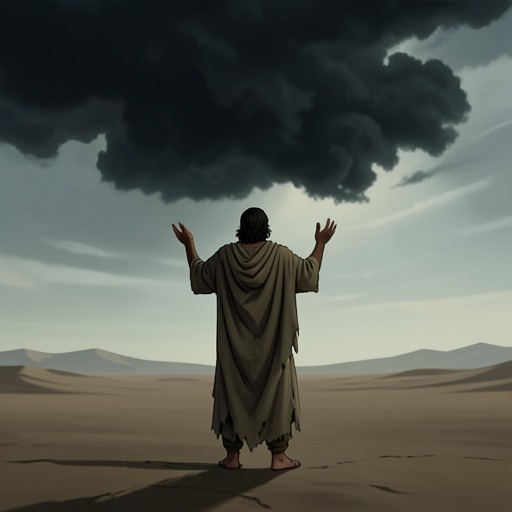
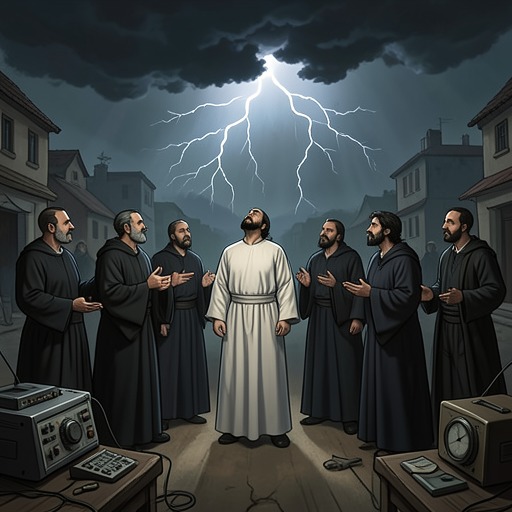
Book of JobGod Answers Job from the Whirlwind is the climactic encounter in which God responds to Job’s long demand for an answer, but not by explaining why he has suffered. God speaks from the whirlwind, challenges Job’s authority and knowledge, and shifts the debate from the justice of one man’s affliction to the scale and unruliness of the created world. The encounter offers Job no account of the design behind his losses; its force lies instead in making the limits of his understanding impossible to ignore.
Place in the Debate
Before God speaks, Job has framed his suffering as a case that ought to be heard. He asks how a man can be just with God and observes that, if he contends with God, he cannot answer even one question in a thousand. The difficulty is not merely that Job expects to lose an argument: he says God is not a man with whom he can meet in judgment, and laments that there is no daysman between them to mediate. His appeal reaches for a witness in heaven, while his bitter complaint insists that his affliction weighs more heavily than his groaning.
Job’s request grows more explicit as the dispute proceeds. He longs for someone to hear him and for the Almighty to answer; he even imagines his adversary having written a book. These are the terms of a petitioner seeking a hearing, an account, and a judgment. The speech from the whirlwind takes up that legal shape but reverses its direction. Instead of presenting reasons for the sentence Job believes he has suffered, God questions the petitioner. The drama’s central reversal is not that Job receives the explanation he demanded, but that the encounter changes who is asking and who must answer.
The First Challenge
God opens by challenging Job’s speech as knowledge without adequate understanding, then commands him to prepare for questioning: “Gird up now thy loins like a man; For I will demand of thee, and answer thou me.” The first question establishes the immense disparity between the disputants: “Where wast thou when I laid the foundations of the earth?” Job is asked to account for the world’s making, its measures, and the ordering of its powers, matters that precede his life and exceed his experience.
The questioning moves through phenomena whose origins and operations Job cannot claim to have mastered. God asks whether he has entered the treasures of snow or seen the stores of hail. Elsewhere in the speech, rain falls upon wilderness where no man is, and the created world includes the Raven, Wild ass, Ostrich, Horse, and Eagle. The range matters: the world God presents is not arranged as a tidy illustration of human moral expectations. It contains remote, wild, and difficult-to-explain realities, and its workings are not made legible simply because a human sufferer demands that they be.
The Second Challenge
God speaks again in the next movement of the encounter, pressing Job on the relation between judgment and righteousness. The challenge asks, “Wilt thou also disannul my judgment? wilt thou condemn me, that thou mayest be righteous?” The question makes explicit the danger in Job’s proposed case: to vindicate himself by condemning God would require him to occupy a position from which he could judge the whole order he does not control. God also asks whether Job has an arm like God’s, turning the question of moral authority into a question of power as well as knowledge.
This is not a point-by-point account of why Job lost his prosperity, children, and health. God does not disclose a chain of causes that would reconcile each loss with a principle of retribution. Instead, the answer widens the frame. Job’s case remains serious, but it cannot be decided from the small portion of the world available to him. The speech thus answers his demand in a manner that resists the form of answer he sought: it presents the limits of the court’s human petitioner rather than a defense organized around his individual calamity.
Effect and Aftermath
The interpretive force of the scene depends on its refusal to settle into a conventional rebuttal. God does not enter merely to resolve Job’s questions; he asks questions of his own. The speech turns skepticism back upon the skeptic, making knowledge—not simply belief—the subject under examination. Its catalogue of natural processes and creatures presses beyond what Job can explain, but this does not amount to a simple claim that suffering is therefore just. The speech withholds that kind of explanation. Its effect is to confront Job with a reality larger than any moral scheme the disputants have managed to construct.
Job is nevertheless changed by the encounter. The account of the poem’s climax emphasizes that God’s riddles seem darker than Job’s own, yet Job is comforted after hearing them; he has been told nothing that solves the original problem, but the presentation of what he cannot penetrate satisfies him. The speech’s impact, then, is relational and experiential as well as argumentative: Job meets the God he had demanded should answer him, even though the meeting does not yield a transparent explanation of divine purpose.
The aftermath also prevents the scene from being read as a simple vindication of Job’s friends. God rebukes Eliphaz and his two companions for not speaking rightly, while saying that Job has; he instructs them to bring seven bullocks and seven rams and go to Job, who will pray for them. God accepts Job, and the friends follow the command. The close therefore distinguishes Job’s anguished challenge from the friends’ confident defense: the speech has confronted Job, but the final judgment does not treat his accusers as the more faithful speakers. The answer from the whirlwind leaves the reason for Job’s suffering undisclosed while overturning the assumption that human beings can confidently explain the whole moral order.